Delta Transformer Connections Explained: A Practical Buyer’s Guide to Delta-Delta, Delta-Wye, and Open Delta
Choosing between a delta and wye winding is more than a symbol on a single-line diagram—it directly controls your load voltages, neutral availability, harmonic heating, and ground-fault protection. Whether you are specifying a new Three-Phase Pad-Mounted Transformer, an indoor cast-resin Dry-Type Transformer, or a utility-grade Oil-Immersed Distribution Transformer, use our practical engineering guide below to match the right winding configuration to your facility, avoid costly sizing mistakes, and verify nameplate compatibility before you order.
Need a Fast Engineering Review? Have a load schedule, single-line diagram, or an existing transformer nameplate to match? Contact GE Transformer Engineers for a free connection review and technical quotation within 24 hours.
1. Delta vs. Wye Windings: Core Differences & Vector Groups
Before comparing complete three-phase transformer banks, you only need to answer three practical questions for your site: What voltages do your loads require? Do your circuits need a neutral conductor? And how must the transformer coordinate with your upstream supply and protection relays?
In a closed delta winding, three phase windings are connected end-to-end in a closed triangle, with line terminals brought out from the three corners and no common star point. In a wye (star) winding, one end of each winding joins at a common center point, which can provide a neutral conductor only when brought out through a dedicated bushing.
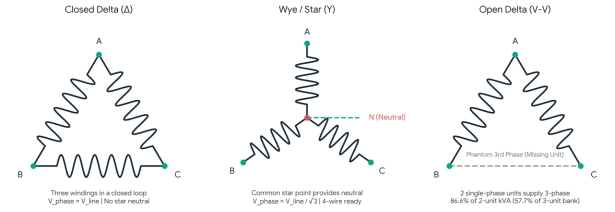
Under balanced, sinusoidal three-phase operation (where ‘phase’ refers to an individual transformer winding), closed delta and wye windings follow these electrical relationships:
| Electrical Quantity | Closed Delta Winding | Wye Winding |
| Winding Voltage | V_phase = V_line | V_phase = V_line / √3 |
| Winding Current | I_phase = I_line / √3 | I_phase = I_line |
| Star-Point Neutral | None | Available if brought out |
| Typical Application | 3-wire motor and industrial loads | 4-wire mixed lighting and power |
For example, a 480 V delta winding places the full 480 V across each individual phase winding. By contrast, a 480Y/277 V wye winding delivers 480 V line-to-line for three-phase machinery and 277 V line-to-neutral for industrial lighting. Total balanced three-phase apparent power is calculated as: S(kVA) = (√3 × V_line × I_line) / 1000.
Two Specifying Rules Every Buyer Should Check
- Specify Neutral Availability and Grounding Separately: Ordering a ‘wye winding’ does not automatically mean a usable neutral terminal is brought out. Always specify whether the neutral bushing must be brought out for 4-wire service and whether the neutral will be solidly grounded, impedance grounded, or ungrounded.
- Verify the Full IEC Vector Group (Dyn11 vs. Dyn1): In IEC notation, uppercase letters denote the high-voltage (HV) winding and lowercase letters denote the low-voltage (LV) winding. For instance, Dyn11 specifies a delta HV winding, a wye LV winding with an accessible neutral, and a 30-degree phase shift where the LV phasor leads the HV reference (11 o’clock position), whereas Dyn1 lags by 30 degrees. Never rely on the label ‘Delta-Wye’ alone when replacing or paralleling a unit—always match the exact vector group, terminal markings, and phase sequence.
2. Comparing the Four Standard Three-Phase Connections
A three-phase transformer can combine delta or wye connections on either the primary or secondary side. You can also explore our comprehensive Ultimate Guide to Three-Phase Transformers and Industrial & Manufacturing Transformer Solutions for broader system context. Use the comparison table below to narrow down the right topology for your project:
| Connection Type | Secondary Neutral | Primary Selection Reason | Critical Engineering Check |
| Delta-Delta | None | 3-wire industrial motor and heating loads | System grounding and single-phase winding overload |
| Delta-Wye | Available | 4-wire commercial and plant distribution | Neutral current rating, grounding, and 30° shift |
| Wye-Delta | None | Generator step-up or grounded HV supply | Primary neutral grounding and protection reach |
| Wye-Wye | Available | 4-wire systems required on both sides | Core construction, zero-sequence path, and tertiary winding |
Practical Note on Turns Ratios: If you define the per-phase winding turns ratio as a = N_primary / N_secondary, the line-to-line voltage ratio is a for Delta-Delta and Wye-Wye, a / √3 for Delta-Wye, and √3 × a for Wye-Delta. However, a manufacturer’s nameplate voltage rating (such as 13.8 kV to 480Y/277 V on a high-capacity Power Transformer) already includes the √3 connection factor—never multiply or divide a stated nameplate voltage ratio by √3 again.
Not Sure Which Winding Topology Fits Your Load Schedule? Send us your primary supply voltage, secondary equipment list, and grounding requirements. Upload Your Load Schedule for a Free Check.
3. When Delta-Delta Is the Right Choice (And 3 Sizing Traps to Avoid)
A Delta-Delta transformer is a rugged, cost-effective solution when your secondary feeds purely three-wire, line-to-line loads such as three-phase industrial motors, pumps, and crushers in Mining Industry Transformer Solutions and heavy automated production lines. Before finalizing a Delta-Delta specification, our engineering team recommends checking three critical details:
- Check Individual Winding Loading on Mixed Loads: If your Delta-Delta bank supplies three-phase motors alongside single-phase line-to-line loads (such as single-phase heaters or welders), simply adding up total connected kVA is not enough. Unevenly distributed single-phase loads can severely overload one phase winding even when total bank kVA looks well below nameplate rating. Always size the bank based on the most heavily loaded individual winding.
- Distinguish Trapped Triplen Harmonics from Harmonic Cancellation: A closed delta winding provides an internal circulating path for zero-sequence triplen harmonics (3rd, 9th, 15th), preventing them from entering the upstream supply lines. However, circulating harmonic currents still generate heat (I²R losses) inside the delta windings, and non-triplen harmonics (5th, 7th, 11th) pass right through. If your facility runs heavy variable frequency drive (VFD) or rectifier loads, ask our team about a Drive Isolation Transformer, a K-Factor Rated Transformer, or a dedicated Harmonic Mitigating Transformer.
- Separate 3-Unit Banks vs. Common-Tank Three-Phase Units: A bank assembled from three separate single-phase Pole-Mounted Transformers or Single-Phase Pad-Mounted Transformers can often be reconfigured into an emergency open-delta bank after isolating a failed unit. Do not assume this applies to a single integrated three-phase transformer sharing a common core and tank—a winding fault inside a common tank requires full testing and manufacturer clearance before re-energizing.
4. How Delta-Wye Powers Commercial & Industrial Distribution
Delta-Wye is the workhorse configuration whenever a three-wire medium-voltage or 480 V supply must feed a secondary system containing both three-phase machinery and single-phase line-to-neutral loads in Commercial Building Power Distribution Solutions and Data Center & Blockchain Transformer Solutions.
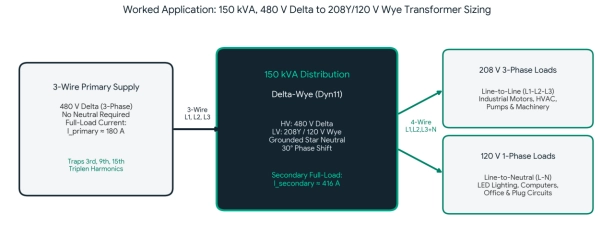
Worked Sizing Example: 150 kVA, 480 V Delta to 208Y/120 V
Consider a 150 kVA, 480 V delta primary to 208Y/120 V wye secondary Dry-Type Isolation Transformer, Encapsulated Transformer, or liquid-filled distribution transformer serving a commercial building or manufacturing bay. Its secondary simultaneously supplies 208 V three-phase power and 120 V single-phase circuits. At balanced full load, the rated terminal line currents are:
- Primary Full-Load Current (480 V Delta): 150,000 / (√3 × 480) ≈ 180 A
- Secondary Full-Load Current (208Y/120 V): 150,000 / (√3 × 208) ≈ 416 A
While 180 A and 416 A establish the baseline full-load currents, final feeder conductor sizing and overcurrent protection must also account for motor starting inrush, harmonic duty, impedance (%Z), and tap positions.
Neutral Harmonics and the High-Leg Delta Warning
- Oversize Neutrals for Nonlinear Single-Phase Loads: When a 208Y/120 V or 480Y/277 V secondary feeds LED lighting, servers, or switch-mode power supplies, triplen harmonic currents add constructively in the neutral conductor rather than canceling out. Always specify whether an oversized neutral bus or double-neutral terminal is required.
- Never Confuse 208Y/120 V Wye with a 240/120 V High-Leg Delta: In a center-tapped 240/120 V high-leg delta system, all three line-to-line voltages measure 240 V, and two phases measure 120 V to neutral—but the third ‘high leg’ measures approximately 208 V to ground. It is not interchangeable with a symmetrical 208Y/120 V wye system, and connecting 120 V line-to-neutral equipment to the 208 V high leg will immediately damage the load.
5. Open-Delta (V-V) Connections: True Capacity Math & Motor Limits
An open-delta (or V-V) bank uses just two single-phase transformers to deliver full three-phase line-to-line voltages, because the third line-to-line voltage is automatically established by the phasor relationship between the other two windings. Transformer Solutions for Utilities and Transformer Solutions for Islands & Remote Areas frequently use open-delta banks either as a planned, budget-friendly setup for light three-phase loads expecting future expansion, or as an emergency contingency after one unit in a three-transformer bank fails.

Why Is Open-Delta Capacity Listed as Both 57.7% and 86.6%?
Both percentages are correct—they simply compare the open-delta output against two different baselines. For two identical single-phase transformers each rated at T kVA, the maximum balanced three-phase open-delta capacity is S_open = √3 × T, whereas a three-unit closed-delta bank provides S_closed = 3 × T:
- 57.7% of Original 3-Unit Bank Capacity: S_open / S_closed = √3 / 3 = 57.7%. Losing one unit out of three reduces total bank capacity by more than one-third (a 42.3% drop).
- 86.6% of Installed 2-Unit Nameplate Rating: S_open / (2 × T) = √3 / 2 = 86.6%. Because of internal phase-angle differences, the two remaining transformers can only deliver 86.6% of their combined nameplate kVA.
Quick Field Example: Two 50 kVA single-phase units connected in open delta provide √3 × 50 ≈ 86.6 kVA of three-phase capacity (about 104 A at 480 V), compared to 150 kVA when all three 50 kVA units are installed in closed delta.
Screening Voltage Unbalance for Three-Phase Motors
Under real-world loading, internal impedance drops across an open-delta bank can introduce line voltage unbalance, which causes disproportionate current unbalance and excess heating in three-phase induction motors. You can screen steady-state magnitude unbalance in the field using: Voltage Unbalance (%) = (100 × Maximum Deviation from Average Line Voltage) / Average Line Voltage. For example, if measured line voltages are 478 V, 482 V, and 480 V, the average is 480 V and the maximum deviation is 2 V, yielding a 0.42% voltage unbalance.
6. Fast-Track RFQ Checklist & Paralleling Verification
To help our engineering team provide an accurate quotation and technical datasheet on the first reply, include these five key details when submitting your inquiry to GE Transformer:
| RFQ Parameter | Details to Include in Your Inquiry |
| 1. Load Schedule | Total kVA, 3-phase motor ratings, and single-phase load distribution |
| 2. Voltage & Taps | Primary voltage, secondary voltage, frequency (50/60 Hz), and tap range |
| 3. Neutral & Harmonics | Accessible neutral bushing requirement, VFD content, and K-factor duty |
| 4. System Grounding | Solidly grounded, impedance grounded, or ungrounded protection scheme |
| 5. Paralleling / Retrofit | Existing transformer nameplate photo if paralleling or replacing a unit |
Critical Check for Paralleling Transformers: Matching kVA and a general ‘Delta-Wye’ label is never sufficient for parallel operation. Before paralleling two transformers, you must verify identical voltage ratios at the operating tap, identical vector group (phase displacement), matching polarity and phase sequence, and compatible percentage impedance (%Z) and X/R ratios. Ready to Specify Your Next Transformer? Whether you need a standard Delta-Wye Pad-Mounted Transformer, a heavy-duty Delta-Delta Industrial Isolation Transformer, or custom step-up units for Solar Power Transformer Solutions and Energy Storage (BESS) Transformer Solutions, our engineers are ready to help. Send Your Inquiry & Nameplate Photo Today for a fast technical review and factory-direct quote.
7. Frequently Asked Questions (FAQ)
Q1: When should I choose a Delta-Delta transformer over a Delta-Wye transformer?
A: Choose Delta-Delta when your secondary system exclusively serves three-wire, line-to-line industrial loads (such as 480 V or 240 V three-phase motors) with no need for a line-to-neutral voltage, or when assembling a bank of three single-phase transformers where open-delta contingency operation is desired. Choose Delta-Wye whenever you need a stable 4-wire secondary with a grounded neutral to supply both three-phase equipment and single-phase lighting or receptacle circuits.
Q2: Does a delta winding eliminate all power system harmonics?
A: No. A closed delta winding traps zero-sequence triplen harmonics (3rd, 9th, 15th) by allowing them to circulate inside the delta loop rather than flowing into the supply lines, but those circulating currents still generate heat in the windings. Furthermore, 5th, 7th, and 11th harmonics are not trapped by a standard delta winding and require a K-Factor Rated Transformer or a Harmonic Mitigating Transformer.
Q3: Why does my open-delta bank only deliver 86.6% of the two transformers’ combined kVA?
A: In a two-transformer open-delta (V-V) bank, winding currents are out of phase with load currents by 30 degrees, limiting maximum balanced three-phase output to √3 / 2 (86.6%) of the two installed units’ combined nameplate rating, or √3 / 3 (57.7%) of the original three-unit closed-delta bank capacity.
Q4: Can I parallel a Dyn11 transformer with a Dyn1 transformer?
A: No. Although both are Delta-Wye transformers, Dyn11 leads the high-voltage reference by 30 degrees while Dyn1 lags by 30 degrees, resulting in a 60-degree phase angle difference between their secondaries that would cause severe circulating fault currents if paralleled.