Transformer Sizes and Ratings: From Load Calculations to a Purchase-Ready Specification
1. Start With the Load, the Supply and the Site
An undersized transformer can overheat, while a poorly matched replacement can delay commissioning or leave you reworking the switchboard. Start with three questions: how much kVA will your loads draw together, which voltage and connection does your system need, and will the unit fit the installation? Use the charts and worked example below to turn those answers into a specification you can send for a quote.
Have a specification or an existing nameplate?
Send the drawing, load schedule or nameplate photo to GE Transformer for a preliminary match and a project quote.
2. Read the Nameplate in 30 Seconds
Transformer size can mean electrical capacity or physical dimensions. A 630 kVA rating tells you how much apparent power a unit is designed to supply under its specified conditions. For the footprint, transport weight and terminal positions, use the manufacturer’s general arrangement (GA) drawing.
| Nameplate item | What it means | What to confirm before ordering |
| kVA / MVA | Apparent power. 1 MVA equals 1,000 kVA. | Simultaneous demand, growth allowance and the required cooling stage. |
| kW and power factor | kW is real power. At the same kW, lower power factor requires more kVA. | Use electrical input kW and the power factor at the operating point. Motor shaft kW alone omits motor losses. |
| Primary and secondary kV / V | Rated voltages on each side. | Check line-to-line and line-to-neutral values, tap range, winding connection and insulation level. |
| A and %Z | Rated current and short-circuit impedance. | Check both winding currents, switchgear duty and the impedance used in the system study. |
| Hz | The frequency for which the unit is rated. | Confirm the site frequency and the offered voltage at that frequency. |
| Ambient, temperature rise and cooling | The installation conditions and heat limits behind the rating. | Check the air temperature at the unit, ventilation, elevation and capacity with fans unavailable. |
Why do manufacturers rate transformers in kVA? The windings carry current, and the core is designed for a specified voltage and frequency. Your load’s power factor changes the kW it draws at a given kVA. For connections and phase relationships, see our three-phase transformer guide.
3. Compare Standard kVA Sizes and Transformer Configurations
“Standard size” depends on the catalogue and equipment class. The examples below help you shortlist a capacity. Confirm the exact voltage pair, frequency and available rating for your project.
| Catalogue family | Example ratings (kVA) | How to use the list |
| Square D US single-phase LV | 25, 37.5, 50, 75, 100, 167 | Check the specific LV family and voltage combination. |
| Square D US three-phase LV | 45, 75, 112.5, 150, 225, 300, 500, 750 | Useful for comparing North American building distribution catalogue sizes. |
| Square D US three-phase MV | 1,000, 1,500, 2,000, 2,500, 3,000 | Check the utility specification and available configuration. |
| GE Transformer MV/LV cast resin example series | 250, 315, 400, 500, 630, 800, 1,000, 1,250, 1,600 | Compare the 11 kV class cast resin distribution transformer catalogue and confirm the offered voltage and cooling. |
Source for the US examples: Schneider Electric US catalogue FAQ. Residential developments, commercial sites and industrial plants have different load profiles. Utility-approved diversity or a site load study matters more than the building label.
| Configuration | Where to start | Order check |
| Single-phase pole-mounted transformer | Utility-approved overhead service for dispersed loads. | Primary line-to-ground or line-to-line connection, pole loading and mounting hardware. |
| 100 kVA single-phase pad-mounted transformer | Underground single-phase service for a residential development or other suitable load. | Secondary voltage, radial or loop feed, and utility-approved compartment and bushing arrangement. |
| Three-phase pad-mounted transformer | Ground-level service with underground feeders. | Feed arrangement, connector interface, cable entry and pad drawing. |
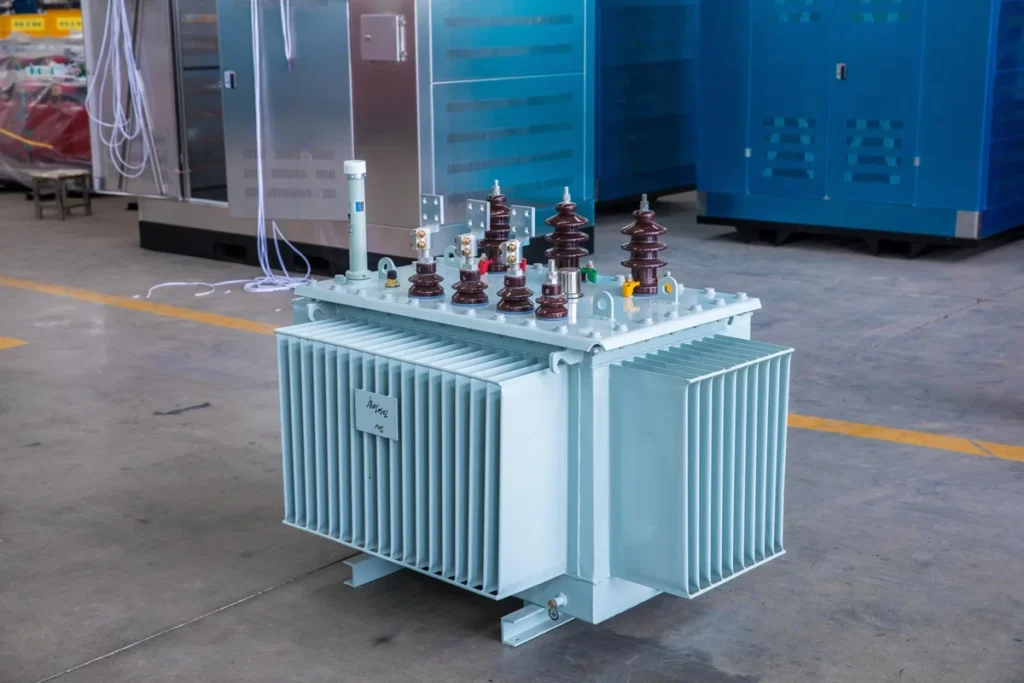
| Oil-immersed distribution transformer | Outdoor MV/LV distribution for a utility or industrial site. | Fluid, cooling, fire separation and spill containment requirements. |
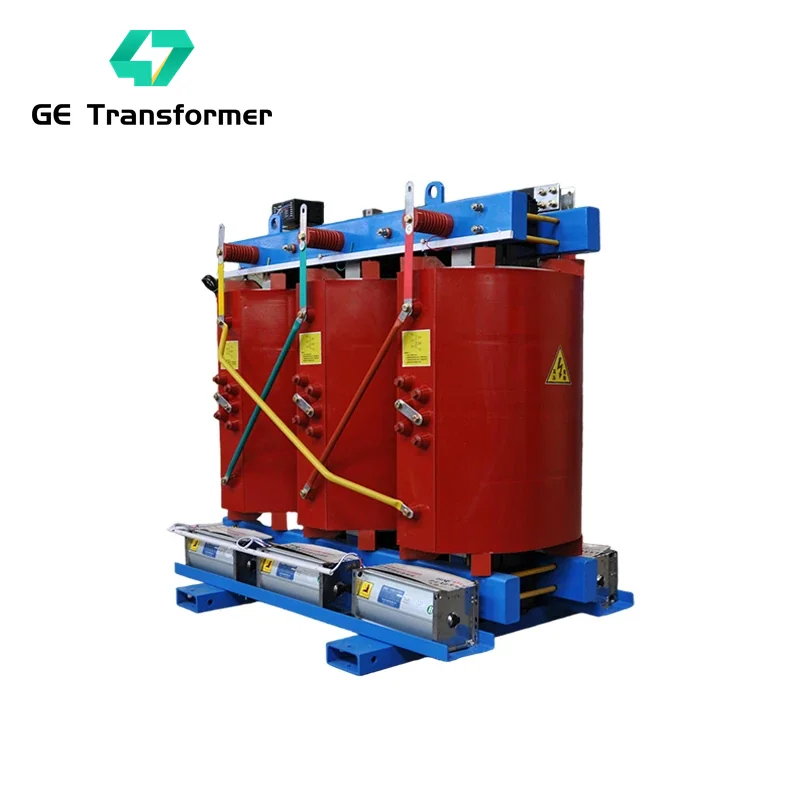
| Cast resin dry-type transformer | Indoor MV/LV distribution where the project calls for dry insulation. | Ventilation, enclosure, temperature rise and natural-air rating. |
4. Avoid Three Sizing Mistakes That Show Up After Installation
- Using average demand for a load with hard starts. Record the running load, largest motor starting current, starting method, duration, starts per hour and allowable voltage dip. Transformer energisation inrush is a separate protection check. For a plant with several large drives, see our industrial transformer solutions.
- Assuming the catalogue rating applies to your room or enclosure. A hot room, high elevation, restricted airflow or sustained harmonic currents can change the usable capacity. Send the temperature profile, elevation, cooling arrangement and harmonic spectrum where available. Ask for a written rating at those conditions.
- Accepting the same kVA as proof of fit. Compare vector group, neutral and earthing arrangement, taps and impedance. Overlay the old and proposed GA drawings to check the footprint, anchor locations, cable reach and door or radiator clearance.
5. Work Through a Three-Phase Transformer Sizing Example
Consider an illustrative manufacturing site with an 11 kV, 50 Hz supply and a balanced 400 V three-phase load. The load schedule shows 480 kW of coincident electrical demand at 0.90 power factor. A confirmed expansion adds 60 kW at the same power factor and is expected to run at the same time.
Calculate load kVA and check the catalogue
| Step | Calculation | Purchase decision |
| 1. Existing demand | 480 ÷ 0.90 = 533.3 kVA | Use coincident demand from the load schedule. |
| 2. Future demand | (480 + 60) ÷ 0.90 = 600 kVA | Allow for the documented expansion. |
| 3. Catalogue shortlist | 630 kVA gives 30 kVA of nominal margin over 600 kVA. | Keep 630 kVA on the shortlist if the supplier confirms at least 600 kVA under site conditions and the system studies pass. |
| 4. Secondary current | 600 kVA ≈ 866 A demand. At 630 kVA the rated current is ≈ 909 A. | Give the electrical designer both figures for the feeder and switchboard review. |
Single-phase: S (kVA) = V × I ÷ 1,000
Balanced three-phase: S (kVA) = √3 × VLL × IL ÷ 1,000
Use RMS voltage and current from the same side. VLL is line-to-line voltage in volts and IL is line current in amps. Reverse the equation to obtain rated current. If V and I already give you kVA, the power factor is only needed when converting between kVA and kW. For an unbalanced load, check the individual phases and neutral.
Unsure whether the calculated rating will work on site?
Share your supply voltage, load schedule, motor starting data and site conditions. Our engineering team can review the shortlist and identify what needs confirmation before you order.
Check voltage regulation, losses and fault current
| Check | Calculation and basis | Why it affects the order |
| Voltage regulation | 100 × (Vno load − Vload) ÷ Vload, at the same primary voltage and tap, using the specified load and power factor. | Check terminal voltage at operating load. Assess transient motor starting voltage dip separately. |
| Efficiency | 100 × Pout ÷ (Pout + Ploss), with real power in consistent units at the stated load and power factor. | Compare guaranteed no-load and load losses on the same test basis. Use your duty profile to estimate energy cost. |
| Short-circuit impedance | %Z is the percentage of rated voltage needed to circulate rated current with the opposite winding shorted, on the stated rating and test basis. | Use the offered %Z and X/R or R and X data for regulation, protection and load-sharing studies. |
| Secondary terminal fault | Isc ≈ Irated ÷ (%Z ÷ 100), for a balanced three-phase bolted terminal fault and negligible upstream impedance. | If this example unit were offered at 6% impedance, the transformer-only estimate would be about 15.2 kA symmetrical RMS. Use a site study with actual source data, transformer tolerances, feeders and other contributions for equipment duties. |
For the calculation method, see the Schneider Electric terminal fault-current guide.
100 kVA transformer load capacity at a glance
| Supply at the load | Full-load line current | Real load at 0.80 PF |
| 240 V single-phase | 416.7 A | 80 kW |
| 400 V three-phase | 144.3 A per line | 80 kW total |
| 480 V three-phase | 120.3 A per line | 80 kW total |
These are rated-load calculations for the stated voltage and phase arrangement. For a 120/240 V split-phase unit, verify the loading of each 120 V leg and the neutral separately.
6. Check Special Duty, 1,600 kVA Designs and Replacement Fit
When a catalogue unit needs a separate engineering review
| Condition | What to confirm |
| 50 Hz site with a 60 Hz-only nameplate | Hold the order until the manufacturer confirms the exact voltage, frequency and usable kVA. Running at the same voltage raises volts per hertz by 20%. A passive transformer leaves supply frequency unchanged. |
| High ambient, altitude, salt or dust | Give the supplier the actual maximum ambient, elevation, humidity, salt or dust exposure, and enclosure constraints. Review insulation clearances and cooling. See our island and coastal power solutions for application context. |
| UPS, rectifier, solar or BESS duty | Supply the converter duty profile, power-flow direction and harmonic data. For dry-type nonlinear loads, a K-factor-rated transformer may address additional heating. Verify the actual duty with the supplier. |
| Parallel operation | Provide both nameplates and the one-line diagram. Verify ratios at the proposed taps, polarity, phase sequence and displacement, compatible %Z and X/R, load sharing and combined fault level before approving the design. |
What changes at 1,600 kVA?
For an illustrative 1,600 kVA three-phase transformer rated 11 kV/400 V, the primary rated current is about 84 A and the secondary rated current is about 2,309 A. At that secondary current, busbar orientation, terminal ratings, enclosure size and access for lifting can determine whether the design is viable. Request an approved GA drawing, transport weight and dimensions, and terminal layout before releasing the purchase order.
Specify the destination and utility at the enquiry stage
| Destination | What to ask the project owner or utility for |
| Australia and New Zealand | Applicable AS/NZS 60076 parts, network-approved equipment and connection details, and project loss requirements. |
| North America | Exact service voltage, frequency, applicable IEEE C57 or CSA product requirements, utility interfaces and any energy efficiency or certification requirements in scope. |
| Middle East | Utility acceptance criteria, outdoor design ambient, sun exposure and enclosure requirements for dust or sand where applicable. |
| Southeast Asia | Local voltage and frequency, utility connection details and any humidity, salt exposure or flood elevation requirements. |
| Africa | National utility specifications and site conditions. For remote or islanded installations, give the generator or inverter contribution and starting duties. |
| South America | Utility-approved voltage and frequency, applicable national product and loss requirements, and altitude at the actual site. |
| Eastern Europe | Applicable national adoption of IEC or EN standards, distribution operator requirements and efficiency obligations for the country and equipment class. |
For scope, check IEC 60076-1, IEC 60076-11 for dry-type equipment within its voltage scope, IEEE C57.12.00 for covered liquid-immersed units, or AS/NZS 60076.1. State the edition and applicable product standard in your purchase specification.
7. Send a Transformer RFQ Your Supplier Can Quote
Copy the five lines below into your enquiry. For a replacement, attach the old nameplate, one-line diagram and safe-to-take site photos. A drawing or photo of the cable entry and terminal layout can save a round of questions.
| RFQ field | Fill in or attach |
| 1. Project and duty | Country / utility ___ · application ___ · new, replacement or parallel ___ · quantity ___ · required on-site date ___ |
| 2. Supply and load voltage | Primary ___ · secondary ___ · phase ___ · Hz ___ · vector group / neutral ___ · tap requirement ___ |
| 3. Capacity and load | Target kVA or measured kW and PF / A ___ · peak and duration ___ · motors / converters ___ · future load ___ |
| 4. Site and mechanical fit | Indoor/outdoor ___ · maximum ambient ___ · elevation ___ · footprint / weight limits ___ · cable entry and terminal positions ___ |
| 5. Acceptance requirements | Standard and edition ___ · utility approval ___ · %Z and loss limits ___ · test reports or witness FAT ___ · drawings and nameplate attached ___ |
For a replacement, ask the supplier to return a comparison of the old and proposed electrical ratings, impedance, protective interfaces and mechanical layout. Request the drawings, inspection scope, lead time and warranty terms with the quotation. See GE Transformer’s engineering and order process.
Frequently asked questions
Q: What are standard three-phase transformer sizes?
They vary by voltage class, product family and market. Examples in a US low-voltage catalogue include 75, 112.5, 150 and 225 kVA. A medium-voltage distribution series may offer 315, 630, 1,250 and 1,600 kVA. Check the catalogue for the required voltage pair and project standard.
Q: How many amps can a 100 kVA transformer supply?
At rated load, a 100 kVA transformer supplies about 144.3 A per line at 400 V three-phase or 416.7 A at 240 V single-phase. At 0.80 power factor, 100 kVA corresponds to 80 kW under the stated rated conditions.
Q: Can I replace a transformer with a higher kVA rating?
Possibly. Confirm the ratio, frequency, winding connection, grounding, taps and mechanical fit. The project engineer should check the effect on fault current, protection, inrush and the ratings of cables, busbars and switchgear before approving the replacement.
Q: Can transformers of different kVA ratings operate in parallel?
Some can, if the voltage ratios and phase relationships are compatible and the impedance and X/R values allow acceptable load sharing. Verify the load on each unit and the combined fault duty using actual transformer and system data before approving parallel service.
Start with a photo if that’s what you have.
Upload a readable nameplate photo or a site drawing, and tell us where the unit will be installed and what it will supply. GE Transformer can review the starting information and tell you what else is needed for a quote.